
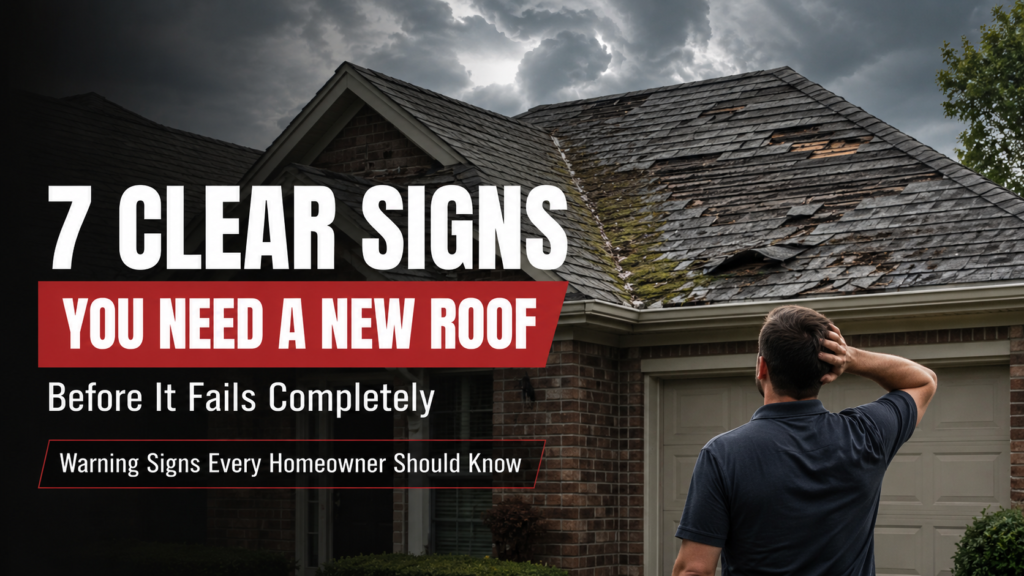
A roof that fails quietly in Texas can turn a $500 repair into a $15,000 replacement, and it rarely gives you much warning. The warning signs are almost always there weeks or months before a leak appears inside your home. Knowing how to read them, how to tell if you need a new roof, and how old your roof actually is could save you tens of thousands of dollars and months of stress.
This guide covers 7 signs you need a new roof, ordered by urgency, from structural emergencies to subtle hidden wear, so you know exactly how serious your situation is and what to do next.
How to Know How Old Your Roof Is
Before understanding the signs, you need a baseline. Many Texas homeowners have no idea when their roof was last replaced, and that number matters.
Three fast ways to find out: check your home inspection report from when you purchased the house, look up permit records through your county appraisal district website, or call a licensed roofer for a visual age estimate based on shingle condition. If your Texas roof is older than 12–15 years, even one of the signs below is reason enough to book an inspection.
The Warning That Shows Signs You Need a New Roof
Let’s discuss the signs you need a new roof so that you can make a timely decision.
- Sagging Roofline or Soft Spots on the Deck
A sagging or uneven roofline means the structural decking underneath your shingles has absorbed moisture and begun to rot or compress. In Texas, this typically develops when years of inadequate attic ventilation bake the deck from below while storm water infiltrates from above, often undetected for months.
Walk your roofline from the ground and look for dips, waves, or unevenness between the rafters. From inside your attic, push gently on the ceiling boards; any soft or spongy resistance confirms a compromised deck. A sagging roof that takes another Texas thunderstorm or hail event before it’s addressed can fail completely. This is seldom a repair situation. If you see this, stop reading and call our expert roofer today.
- Active Leaks or Water Stains in Multiple Locations
A single, isolated leak may be a flashing issue, manageable with a targeted repair. But water stains appearing in multiple rooms or across different ceiling areas signal that the roofing system as a whole is breaking down. Patchwork repairs at this stage are a financial trap.
Mold remediation in Texas can add $3,000–$10,000 on top of your roof replacement cost, a number the Texas Department of Insurance flags as one of the most preventable homeowner expenses with early roof action.
If a ceiling stain grows, changes shape, or keeps returning after you paint over it, treat it as a roofing emergency, not a cosmetic issue. Photograph everything with timestamps before any repairs are made.
- Hail Bruising or Missing Shingles After a Storm
Missing shingles are obvious. Hail, bruising is not. Soft, circular impact marks are nearly invisible from the ground, but they destroy the shingle’s weatherproofing layer, and water infiltration begins at these points within months.
After any significant storm, use binoculars to scan your roof at a low angle. Check your metal mailbox, outdoor AC unit, and gutters for dents. If those surfaces show impact damage, your shingles almost certainly do too. According to NOAA’s National Centers for Environmental Information, Texas recorded 878 major hail events in 2024 alone, more than any other state. If you’re in DFW, San Antonio, or Austin, a post-storm inspection isn’t optional; it’s essential. Photograph any damage with dated photos before filing an insurance claim or authorizing any repairs.
- Granule Loss in Gutters or Bald Shingles
Granules are the UV shield on asphalt shingles. With more than 300 sunny days per year, Texas burns through granules faster than virtually any other climate. Once they go, the underlying fiberglass mat is exposed directly to heat, and degradation accelerates fast from that point.
Check your gutters after a heavy rain. Dark, sand-like grit collecting at your downspout splash blocks is granule loss. Visible bald patches on shingles spotted from the ground mean the process is already well advanced. This is one of the earliest warning signs you need a new roof. Catch it here, and you may still have time to plan a replacement on your terms rather than a storm’s.
If you’re planning a full replacement, explore your residential roofing options with Keown Builders. The team can walk you through material choices built for the Texas climate.
- Curling, Cracking, or Cupping Shingles
Two types of curl tell different stories. Cupping, where shingle edges turn upward, points to a moisture imbalance from a failing underlayment. Clawing, where the middle lifts while edges stay flat, signals UV aging and heat baking. Both create gaps that wind-driven Texas rain exploits during storms.
Here’s what most roofing articles won’t tell you: shingles that curl lose their wind-uplift rating. A roof installed to handle 130 mph winds can drop to an effective 60–70 mph resistance once curl sets in, a dangerous gap during Gulf Coast hurricane season or a DFW supercell.
- Sudden Spike in Energy Bills
Not every roof sign is visible from the outside. A failing Texas roof loses its heat-reflective and insulating properties quietly. Attic temperatures that should peak around 130°F can climb to 160°F through a deteriorating roof, forcing your AC to run 20–30% harder, which shows up on your electric bill before a single indoor leak appears.
If your summer utility costs have increased without any change in habits or thermostat settings, add your roof to the suspect list before assuming it’s your HVAC system. This is especially common in homes with 3-tab asphalt shingles approaching the end of their Texas lifespan.
For commercial properties dealing with energy loss and roof wear, Keown Builders’ commercial roofing team provides assessments specifically designed for flat and low-slope Texas commercial roofs.
- Failing or Deteriorating Flashing
Flashing is the thin metal that seals every roof penetration, such as chimneys, skylights, vents, and valleys. In Texas, the thermal cycling between 20°F winter nights and 110°F summer afternoons causes flashing to expand, contract, and eventually crack its sealant bond. Industry data consistently shows that up to 80% of roof leaks originate at failed flashing, not the shingles themselves.
From the ground, look for rust streaks running down from the base of your chimney or vent stacks. Interior water stains appearing near a skylight or along a chimney wall almost always trace back to flashing failure rather than shingle damage. Caught early, flashing issues are repairable without full replacement. Caught late, after the decking is wet,the repair scope expands dramatically.
Don’t Wait for the Roof to Tell You in the Worst Way
After knowing signs you need a new roof, a free inspection costs you 30 minutes. Waiting costs you exponentially more.
Keown Builders provides honest, no-pressure roof assessments for Texas homeowners, complete with a photo report of what was found, whether you need immediate work or not. No upsells, no manufactured urgency, just a clear picture of where your roof stands and what your options are.If you spotted even one of the signs above, especially if your roof is 10 or more years old, or you’ve had a hail event this season, book your inspection at keownbuilders.com before the next Texas storm decides for you.
FAQS
How do you know a roof needs to be replaced?
If your roof is 15+ years old, showing sagging, curling shingles, granule loss, or repeated leaks in multiple spots, it is past repair territory and needs replacement.
What are the signs of needing a new roof?
The clearest signs are sagging decking, water stains in multiple rooms, hail bruising, bald or curling shingles, failed flashing, and a sudden spike in energy bills.
How many years does a roof usually last?
In Texas, asphalt shingles last 10–20 years, metal roofs 40–70 years, and clay or concrete tile 50–75 years, all significantly shorter than national averages due to heat, UV, and hail exposure.
Should I replace my roof if it’s not leaking?
Yes, by the time a leak appears indoors, the underlying damage is already extensive; granule loss, hail bruising, and curling shingles are all signs your roof is failing before a single drop comes through the ceiling.